Seeing Big Shapes
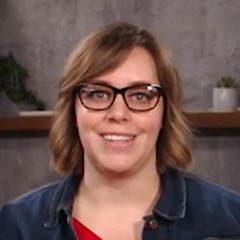
Katie LiddiardEver find yourself overwhelmed by all the details in a scene before you’ve even picked up a brush? You’re not alone. In this insightful lesson, Katie Liddiard shares a clever and accessible exercise to help you train your eye to see the big shapes first so your compositions can start strong before you ever worry about the tiny details.
Katie walks you through her method using a simple photo of horses, a transparency sheet protector, and a dry erase marker. By intentionally blurring the photo in Photoshop before printing it, she forces the eye to ignore small details and focus only on the dominant shapes and values. Then, using the transparency overlay, she begins marking the major masses—sky, trees, foreground, and, of course, the group of horses.
She demonstrates how to create large envelope shapes around the entire subject before refining them further. This process mirrors how artists in the field need to mentally simplify complex scenes—especially with moving subjects like animals. The method also helps you practice identifying shadow patterns, contour flows, and how elements interact spatially.
But the value doesn’t stop there. Katie suggests you could even use this setup to paint directly onto the transparency for practice with color matching and brushwork, making it a versatile tool for both planning and skill building.
By the end, you’ll have a better understanding of how to break complex compositions into manageable parts and train your eye to prioritize form over fussy detail. Whether you're prepping for plein air painting or studying from photos, this is a habit that will dramatically improve your work.
All it takes is a photo, some plastic, and a marker—and you’ve got a powerful learning tool right at your fingertips.
We know that we should work with the big shapes first, before getting into those tiny details. But it can be a little tricky learning how to do that. I'm Katie Lydiard. Let's talk about how we can train our eye just a little bit easier so that we can get those big massive shapes to work together before we get caught up in those tiny details that really make our pieces sparkle. I have a really simple demonstration here.
It's a photograph, um, of these horses that's in a transparency page protector, um, and then I have just a dry erase marker. And what this is going to allow me to do is to make marks on here that I can easily wipe off. So you can see this picture here is just a little blurry, and that's on purpose. I wanted to make sure that I'm not getting caught up in all of these small things. So I took it into Photoshop and I blurred out the whole thing, and then I can, you know, print it off, and now I have it in the transparency, and now I can really focus on how do I want to break this down.
If I'm out in the field, I'm going. I have to mentally work through how I break down the scene, especially if it's live animals, they're going to be moving, right? So I, if I can prepare as much as I can before I go out, how I visually break down a scene, then while I'm out there in the field doing my studies, I'll have a lot easier time getting a great study done. So, with this picture, what I can do is I can start to see what my big shapes are, my big masses. Obviously, I have the sky here that's broken up with these trees.
I have this line. And I do have these houses, but I don't necessarily need to worry about those because they kind of more or less go into the mass of the trees, or at least I'm considering them at this point as part of the mass of the trees. And then as the foreground moves forward. I have kind of this middle ground here into the foreground here. So I have my sky, my background, my middle ground, and then my foreground here.
And of course my subject, the horses, how would I break these up? This is a very complex set of shapes. So what I can do is say, OK, what are my big angles? I have this down to here. I have this overall angle, this overall angle.
That, and that there, that encompasses kind of envelope shapes. My whole subject, right? And then from there, I can start cutting into that envelope. I can cut in there. Start to cut in for the backs of the horses.
Get that neck and his face. The legs a little bit. And then from there, obviously I have that a little bit more cut in, I can erase. My bigger lines so that I can see my smaller lines a bit better. Now I can separate the horses individually.
And from there I can start getting these. Shadow shapes. There are some really clear shadow shapes on these horses, which is nice because that will do a lot of describing as far as form and anatomy, and can get some of these hooves. A bit more specific on. Some of these contours.
And now I have this overall huge shape broken down into much more manageable shapes. I could even, at this point, grab some paint and start kind of filling in on top of this transparency. It's a really great tool. To be able to not only work on seeing those bigger shapes, but color matching and you know, just practicing the act of mixing and applying your paint. It will be a lot more slick of a surface to paint on than, say, a canvas, but it's still a great tool to kind of learn some steps into being able to see your big shapes and applying some paint.
So I hope this is helpful. Please get some photographs and use this tool, this exercise, to be able to see your big shapes for your photos.
Share tips, start a discussion or ask other students a question. If you have a question for an expert, please click here.
Already a member?
No Responses to “Seeing Big Shapes”