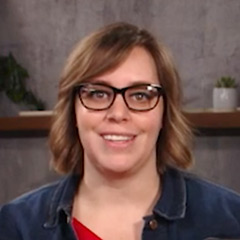
Drawing From Memory
Katie LiddiardHave you ever stumbled across a breathtaking scene—one that absolutely needs to be captured on canvas—only to realize you don’t have your sketchbook or paints with you? It’s a common challenge for artists, but it doesn’t have to stop you. In this lively and practical lesson, Katie Liddiard shows you how to strengthen one of the most powerful tools in your creative toolkit: your memory.
Katie begins by sharing her own process for training visual recall. Using a photograph as a starting point, she demonstrates how to quickly sketch out the scene in its simplest form, focusing on big shapes and their relationships to each other. By practicing with large, general forms rather than small details, you’ll discover how to capture the “essence” of a subject without getting overwhelmed.
From there, Katie walks you through a simple but powerful exercise: cover your initial sketch, then redraw it purely from memory. The first attempt may feel incomplete, but that’s the point. By flipping back and forth, comparing your recall with the reference, and trying again, you’ll build stronger mental habits and sharper observational skills. Over time, these repeated exercises train you to notice more, remember more, and interpret scenes with confidence and creativity.
Katie also shares how this memory training not only helps you reproduce what you’ve seen, but also gives you the freedom to make thoughtful adjustments. Maybe you shift the horizon line slightly, or move a tree for better composition. With practice, you’ll discover how memory and imagination can work hand in hand to strengthen your art.
By the end of this lesson, you’ll walk away with practical tools to capture those unforgettable moments—long after you’ve left the scene behind.
Have you ever come across a scene that has just really impacted you? It's either really beautiful, well designed, or whatever the scene is, and you don't have your art supplies on you. What do you do if you want to go back to the studio and recreate that scene because it was just so perfect, so beautiful, it needs to be on canvas or needs to be on paper, how can you develop your memory in order to recreate that scene? More accurately. Well, we have some tips and tricks.
Hi, I'm Katie Lydiard. Let me show you how I like to train my memory more so that when that happens to me, and it happens quite often, I can be more prepared for when I get back into the studio. How I'm going to start to develop my memory better is I'm going to take a picture of a scene that I want to paint, right? I have this picture here and what I'm going to do initially is I'm going to really start to study. I'll start to draw this out.
In a pretty general way. Focusing on big shapes and how these shapes all connect together. Now, if I want to take some time on this, I can, you know, study this for a few hours. Um, but for this purpose, I'm just gonna kind of get some general shapes going on here. And the smaller you start in terms of complexity, the easier it'll be at first, and then you can start to get more and more complex.
OK, so I have kind of a general idea of the overall shape of my subject here. And I could even, you know, understand where the horizon is, where these trees are in relation to my subject. It's actually come up a bit. Right? And then the separation of the foreground and the middle ground, and then the separation of that background there, OK?
It's kind of messy, but that's OK. Now, what I'm going to do is I'm going to flip these over and try to recreate that. Again, very generally, what can I remember? And this is where you're going to find. A lot of weaknesses and that's OK.
What is it that I actually remember? How did these big shapes all connect together? I know that I had this horse up here. I know that this horse kind of came back here. This horse was over here.
OK, and I had. My trees that came up here. Kind of had some trees here. And then my middle ground here. And that's what I remember right now, and that's, you know, not a whole lot of information, but I'm going to turn this back over and see how I did, and then I'm going to correct a little bit more, um, and I'll redo that and redo that and redo that while I develop that memory so that I can start to really exercise, you know, remembering all of that information, the tiny minutiae of information.
And you know, really strengthen my pieces because of that, because then I can start to interpret the memory a bit more as I, I liked how this was in the initial scene, but I think I can make it a little bit better by altering it a little bit. So next time you come across a scene that you really want to replicate on paper or canvas, do some memory exercises so that you can capture that.
Share tips, start a discussion or ask other students a question. If you have a question for an expert, please click here.
Already a member?
No Responses to “Drawing From Memory”